Monday, September 24, 2007

Nova Scotia

Once we returned from Newfoundland, we stayed on Cape Breton Island (Nova Scotia) for several days and went touring on day trips. One of our excursions took us to the Fortress of Louisbourg, which was France’s capital settlement in the colony of Atlantic Canada in 1744. I was surprised to discover that Canada was much more desirable to France as a source for cod than it was for furs. At the fortress, costumed interpreters described life in the colony. I wouldn’t have enjoyed being a soldier, although the firing of the long rifles was interesting for Morgan and Mason. Elise was thrilled with the opportunity to knit a few rounds for one of the interpreters, while the lady explained how to weave a willow basket to Allan and me. We also saw some wonderful examples of historic costumes.
Next we toured around the Cabot Trail, with beautiful ocean scenes from the cliffs of Cape Breton Highlands National Park. The boys had fun scaling the rocks on either side of Mary Ann Falls, but probably enjoyed Black Sand Beach the best, where we stopped for a picnic. Farther around the Trail we strolled through the 350-year old hardwood forest at the Lone Shieling (a crofter’s cottage). It truly was a fantastic day.
One of the stops I appreciated the most on Cape Breton was going to the Alexander Graham Bell National Historic Site. Sure, he was the man who invented the telephone. But did you know that Alexander Graham Bell also invented the hearing aid, desalination systems to help stranded sailors make fresh water from sea-water, a metal detector, new wing designs for the up-and-coming airplanes of the time, and also a high-speed hydrofoil boat? He also worked with Helen Keller and her teacher Annie Sullivan. He was an amazing man.
From Cape Breton, we headed to Halifax, where we toured the Citadel of the city. The fortress was truly impenetrable in its day, due in part to its star shape. The soldiers in kilts displayed their marching capabilities for us, and we witnessed the firing of the noon canon, as well as a bagpipe and drum concert. We saw where the dreaded Halifax Explosion took place during World War I, and also saw Theodore Tugboat (from the CBC’s children’s program) plying the waters of the harbor.
We found the scenery of Nova Scotia to be awe-inspiring, and would love to return one day.

Monday, September 17, 2007

Newfoundland

From Prince Edward Island we drove directly through Nova Scotia and Cape Breton Island to get to the Newfoundland ferry. The kids and I found the 6-hour crossing to be abit hard on the constitution, but Allan had fun acting like the drunken sailor, weaving from one side of the aisle to the other.


We took a rest day in Corner Brook, and did a day-trip out along the Captain Cook Trail, that borders the Bay of Islands. Captain James Cook surveyed the area in 1767. The scenery was beautiful, with the many islands in the water.


Next, we drove up the Viking Trail to the north, on the western side of the island. We drove through the UNESCO World Heritage Site of Gros Morne National Park, and after 4 or 5 more hours of driving, we found ourselves at the northern tip of Newfoundland. We stayed at Viking RV Park, which got us in the mood for another UNESCO World Heritage Site: L'Anse Aux Meadows. This is the where Norsemen established a settlement in North America around the year 1000 A.D. It was a fabulous site, and the National Park rangers were wonderful at giving us the background of the place: how it was discovered, details about the archaeological dig, and the items discovered that prooved that this was a genuine Norse site.


Later we drove for a half hour to St. Anthony and sat on the cliff for an hour. We managed to see a far-off iceberg (although it was past their season), and a couple of whales swimming by, as well as a couple of pods of porpoises. A real thrill.


On our way back south down the peninsula, we stopped at a provincial park called the Arches. Here we saw how the ocean carved out holes in the rocks, and formed archways. The boys loved climbing all over the rocks.


We returned to the main body of Newfoundland and took a few days to drive along the Trans Canada Highway to St. Johns (first exploring around Twillingate Peninsula). At St. Johns, the colorful houses are a site to see. We learned the history of Signal Hill, and its importance during the World Wars, and also as the point where Marconi received the first trans-Atlantic radio-wave transmissions in 1901.


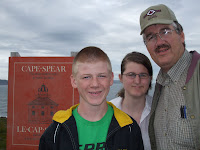
No trip to St. Johns is complete without a stop at Cape Spear, the eastern-most point of land in the Western Hemisphere. We took the appropriate tourist photos, and also toured the historic lighthouse on the cape.


It was time to leave Newfoundland, so we drove across the island again, stopping at the Joey Smallwood view point at Gambo. (Joey Smallwood was the man who brought Newfoundland into Confederation in 1949.) The ferry-crossing back to Nova Scotia was much calmer, and I enjoyed standing at the bow and trying to catch photos of the many pods of porpoises that crossed our path. Alas, they were all too fast, but it was a fun way to end our trip to the wonderful province of Newfoundland. :)


Wednesday, August 29, 2007

PEI

Wow! It's been a long time since we updated.... the trouble with trying to find WiFi.


Prince Edward Island enchanted us with its beautiful scenery. Everyone told us you can drive around the island in a day, but we ended up staying for almost a week. We were impressed first with the construction marvel of Confederation Bridge, which is about 13 kilometers long and has been open for 10 years now. It sure made the trip to PEI fast and painless.


No trip to PEI is complete without a look at the Anne of Green Gables sites. We toured the Green Gables home, upon which Lucy Maud Montgomery based her descriptions of the house in her novel. It was actually the home of a family relative, and she spent a lot of her childhood time there.


We also spent a day at the fictional town of Avonlea, where several actors in costume entertained us all day with singing, races, country fair competitions, and vignettes from the Anne of Green Gables novel. We all got into the spirit of the day, and Allan even entered the manure-toss competition. :)


The kids found it hard to believe that any place would have a museum about 'potatoes', but PEI does. Potatoes are an important part of PEI's economy, and we saw lots of crops of them. While visiting the west side of the island, we also went to Cedar Dunes Provincial Park. The red-sand beach was beautiful, as was the lighthouse there.
We also spent a day at Charlottetown, where we went to 'Province House'. This is where the Charlottetown Conference was held 1864, and the idea of confederation was first discussed. It was quite awe-inspiring to think that our nation became a nation right there. The visitor center's 'time tunnel' took us through the events of 1864 and also showed how each other province joined the country throughout history. That was a neat way to end our tour of the beautiful province of PEI.


Friday, August 10, 2007

After Ottawa, we travelled to Quebec. It was a strange feeling for me, knowing that I could often be my family's soul means of communication with the fracophone population. But I found that the language came back relatively quickly, and I enjoyed talking with people, even in line at the grocery store. Everyone seemed to understand me with no problem, and I even got some comments on how well I spoke. :)

In Montreal, we stayed with Lenore Fletcher, a friend since my Rimouski days. We spent lots of time at the community pool, and were so thankful as we found the Montreal weather to be extremely hot. Lenore's son Jonah is a real dear, and got several ribbons at the swim-meet that we attended. It was nice to visit Old Montreal on our last morning there. The Notre Dame basilica was a highlight.


Our next stop was Quebec City, where we met up with Sylvain and Darcy and family again. It was great to see the same friends a week or so apart on this trip. Sylvain and his daughter Rachel took us to the walled Old City that first evening. It was really fun, as the Festival of New France was on, and there were many partiers dressed in medieval costumes. It seemed to fit so well with the cobblestone streets and the stone buildings that looked like they had come out of a medieval European village. We visited the old city several more time in the following days, as well as the Citadel, which is the star-shaped fortress which is part of the walled city. The Plains of Abraham was right beside the fortress, so the kids saw lots of sites from their Canadian history textbook from last year. We also visited the Museum of Civilization in Quebec City.


We took a quick trip north through forests and mountains, and eventually emerged over a hill to see flat farm land stretching for miles. This was the first time since leaving Alberta and Saskatchewan that we saw the crops of wheat, barley, and oats. We also saw corn, soy beans, sunflowers, and lots of hay being put up. The historic village of Val Jalbert was really interesting; it was an old pulp and paper town, set on a beautiful river with a spectacular waterfall.


After crossing to the south of the St Lawrence River, we met up with the parents of the family with whom I lived when I took my French course in Rimouski in 1987. It was so much fun visiting with them...as if 20 years hadn't passed since we last saw each other. We continued around the Gaspesie, and saw the sight where Jacques Cartier first landed on Canadian soil, in 1534. It fills me with awe to think about it. We continued to the famous Rocher Perce, which is a giant rock with a whole in it, just off the coast. When the tide is out, people can walk out to the huge rock, but when the tide is up the rock is well into the water. We suffered our worst weather at Rocher Perce as we camped on the cliff; the wind and rain were bad enough to close some of the local highways and caused a home of slide down a slope (killing one person). We were sure worried during the night as the wind rocked the motorhome. Thankfully the wind died down the next day, and we were able to continue on our trip.


Yesterday, we just crossed into New Brunswick. We stayed at Sugarloaf Provincail Park last night. It is located at the local ski hill, and has something called an Alpine Slide. This is a small version of a luge run that is used during the summer with sleds on rollers. Allan and I tried it once and it was a lot of fun. We got passes for the kids to go down the run, and that kept them busy for hours. They had a hoot!


We are presently at what is known as the Acadian Peninsula in New Brunswick, and still French is the language used in the community. In a few days or so we hope to go to Prince Edward Island, so I guess our Maritime experience is about to really begin.